RAbHIT — R Antibody Haplotype Inference Tool
Analysis of antibody repertoires by high-throughput sequencing is of major importance in understanding adaptive immune responses. Our knowledge of variations in the genomic loci encoding antibody genes is incomplete, mostly due to the technical difficulty of aligning short reads to these highly repetitive loci. This partial knowledge results in conflicting V-D-J gene assignments between different algorithms, and biased genotype and haplotype inference. Previous studies have shown that haplotypes can be inferred by taking advantage of IGHJ6 heterozygosity, observed in approximately one third of the population.
RAbHIT is a haplotype inference tool based on a robust method for determining V-D-J haplotypes by
adapting a Bayesian framework. The method extends haplotype inference to IGHD, IGHV, IGKJ, IGKV,
and IGLV based analysis, thereby enabling inference of complex genetic events like deletions and
copy-number variations across the population. It also supports the TRB chain. For each haplotyped
gene the tool reports a Bayes factor (lK = log10 of the likelihood ratio) that quantifies the
certainty of the inference.
Core abilities
- Haplotype inference from a J, D, or V gene used as anchor
- Single-chromosome deletion detection
- Double-chromosome deletion detection
- Publication-quality static and interactive (HTML5) visualizations
Supported chains
IGH, IGK, IGL, and TRB.
At a glance
library(rabhit)
data(samples_db, HVGERM, HDGERM)

# one individual, haplotype by IGHJ6
clip_db <- samples_db[samples_db$subject == "I5", ]
haplo <- createFullHaplotype(clip_db,
                             toHap_col = c("v_call", "d_call"),
                             hapBy_col = "j_call", hapBy = "IGHJ6",
                             toHap_GERM = c(HVGERM, HDGERM))
plotHaplotype(haplo)
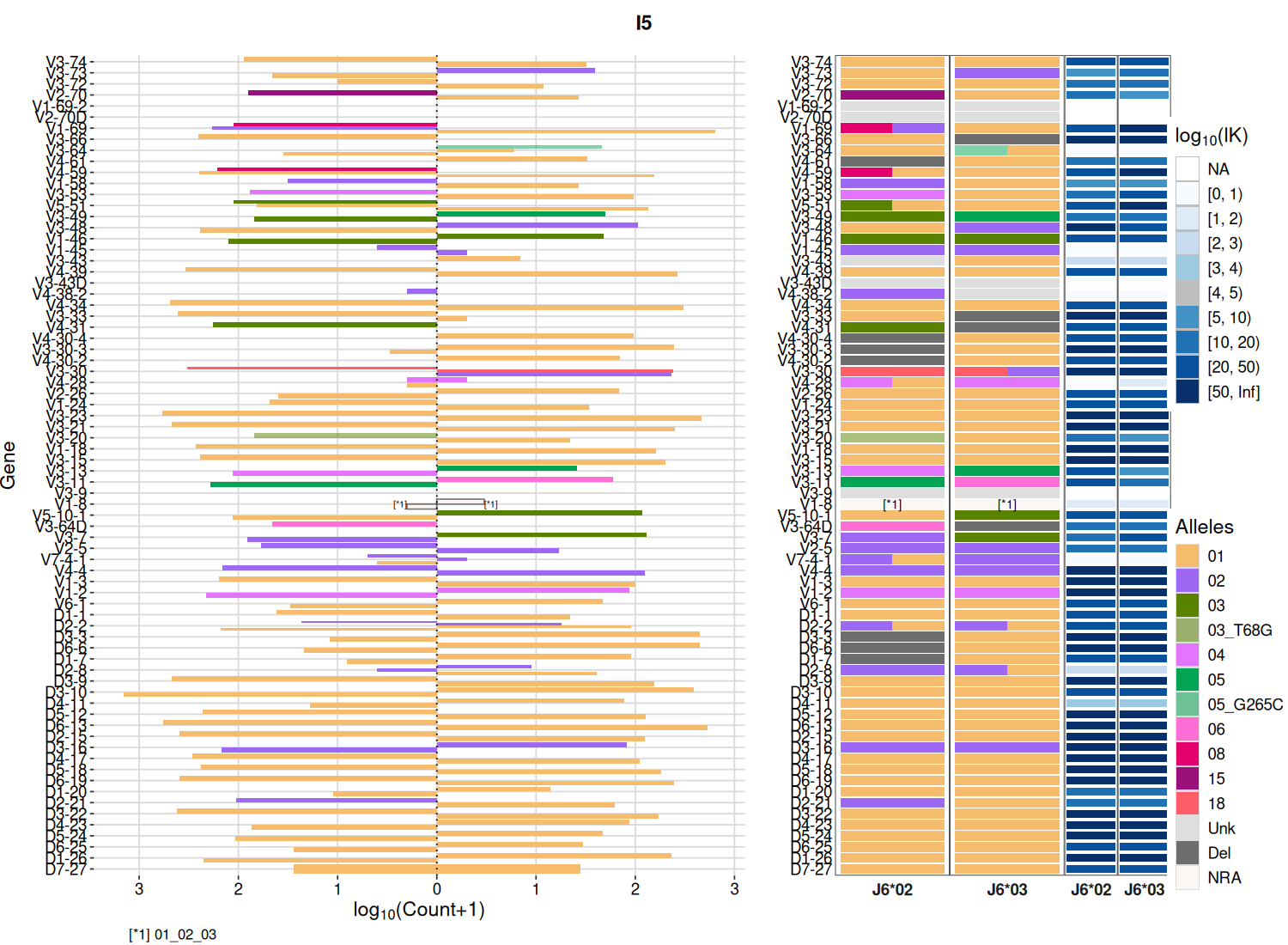
See the Tutorial for the full workflow and the Function reference for the complete API.
Citation
If you use RAbHIT, please cite the papers listed on the Citation page.
RAbHIT is free for use under the CC BY-SA 4.0 license.